Phase 2 – Designing an XAI Prototype (User Flow)
User flow and AI app analysis shaping XAI strategy in my prototype.

Jun 12, 2025
Jun 13, 2025
·
4
min read
Hello everyone!
Welcome to my second blog post, I’m excited to share that Phase 2 of my Master’s thesis is now in full swing. This phase focuses on designing and developing a prototype to explore how Explainable AI (XAI) strategies can enhance the user experience when building travel plans with AI.
AI Travel App Analysis
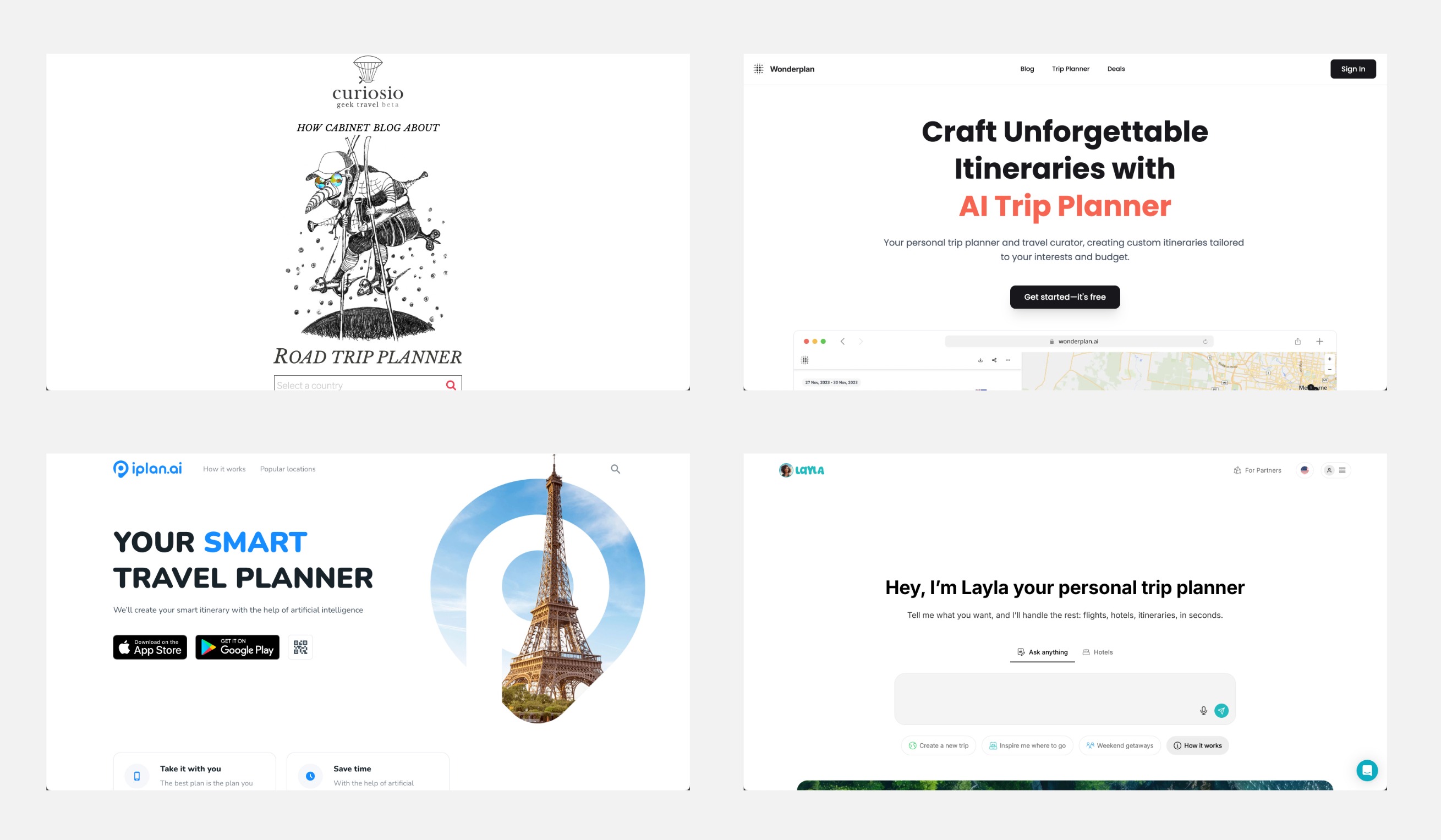
As part of my preparation, I revisited four AI-powered travel planning platforms from my earlier research,
While these tools offer personalised travel suggestions, they often fall short in providing clear, meaningful explanations for their recommendations. They also tend to limit opportunities for real collaboration between the planner and the AI.
This reveals a critical gap in current systems, a lack of transparency and co-creative interaction in which my project is aiming to address through thoughtful integration of XAI strategies.

Selected XAI Strategies for Prototype Testing
The XAI strategies in my prototype are shaped by both academic literature and the rich insights gathered from user interviews in Phase 1.
- Preferred Explanation Formats: Use of bullet points, highlighted sections, and visual aids (e.g., maps, imagery) to facilitate fast and intuitive comprehension.
- Source Transparency: Clearly showing where recommendations come from such as popularity, user reviews, or social proof and stating any limitations or uncertainties.
- Human-like AI Communication: Designing interactions that feel natural, friendly, and engaging.
- Actionable and Trustworthy Guidance: Explanations should be useful, easy to understand, and help users make informed travel decisions.
- Balancing Detail with Simplicity: Avoiding technical jargon and ensuring the interface remains accessible and easy to navigate.
- Local and Global Explanations: Including both local explanations (e.g., “Changing this filter affects X”) and global ones (e.g., “This is how the system typically prioritises destinations”).
- Tailored for Non-Experts: Delivering natural language explanations that justify decisions, catering especially to users without a technical background.
- Semantic Explanations: Using contextual, user-friendly phrasing—like “+5% match to your interests” to improve clarity and minimise cognitive load caused by overly technical or framed language.
User Flow
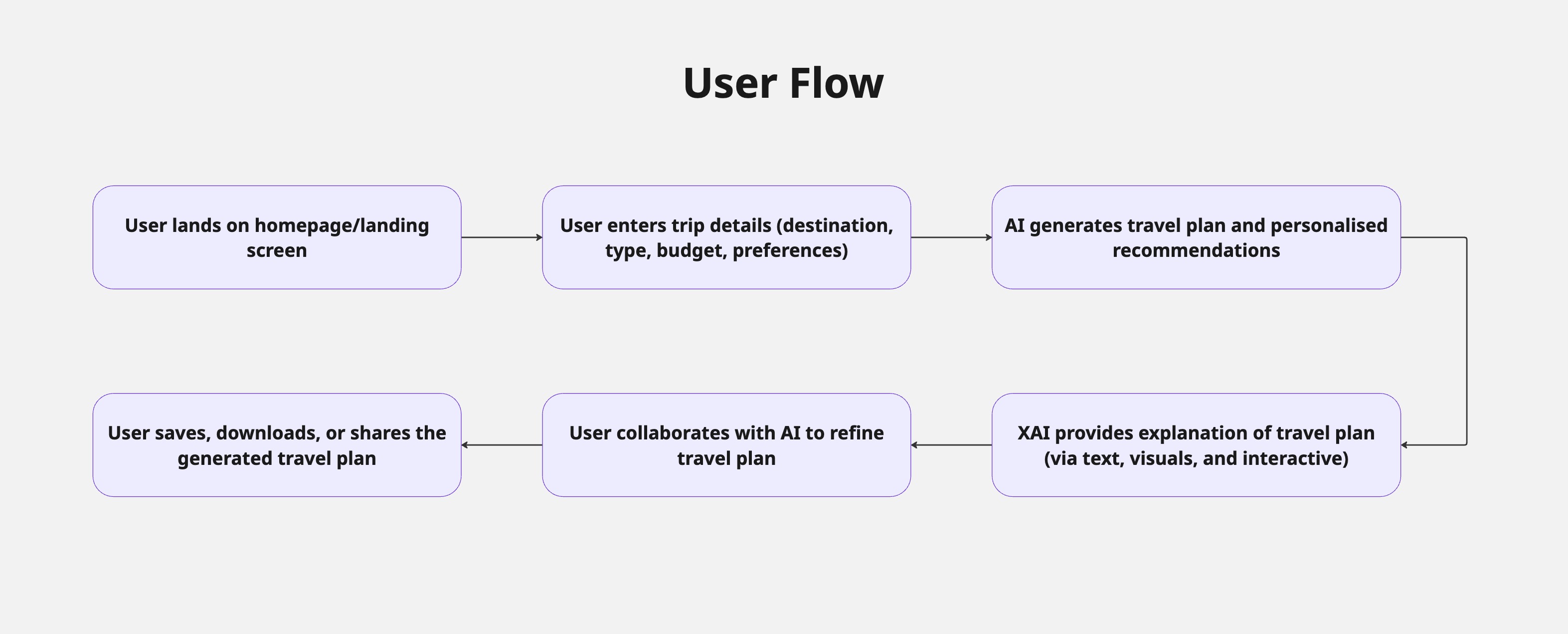
My current focus has been on designing the user flow, mapping how leisure travellers interact with the AI while creating their ideal travel itinerary. This flow highlights key moments where XAI can support decision-making and build user confidence in the recommendations. The completed user flow is attached to this post.
Key steps in the user flow include:
- Collecting travel details to generate a personalised itinerary
- Presenting contextual, engaging explanations
- Enhancing collaboration between the user and AI
- Allowing users to save, edit, and share their travel plans
I’ll be sharing low-fidelity wireframes in my next blog post, so stay tuned!