My Master's Thesis Journey
Kicking Off with the Project Proposal!

May 30, 2025
May 30, 2025
·
5
min read
Introdution
Hello everyone and welcome to the first post in my weekly blog series documenting my Master's thesis journey! Over the coming months, I'll be sharing my progress, insights, findings, and the rollercoaster of research as I work towards completing my MSc in User Experience and Service Design.
This week, I'm diving into the foundational piece of my project: the proposal report. This blog outlines the problem, research questions, and methods I'll be using.
My project is titled "Developing Explainable XAI Strategies to Enhance User Experience in AI-Based Travel Planning". It sits at the intersection of Artificial Intelligence (AI), User Experience (UX), and the ever-evolving tourism industry.
The Heart of the Research
We know that AI is becoming increasingly integrated into travel planning, helping with everything from personalised recommendations to decision-making support. Large Language Models (LLMs) like ChatGPT are seen as potentially revolutionising the sector with services like 24/7 customer service and tailored suggestions.
However, a significant challenge with complex AI models is their "black-box" nature, it's often unclear how they arrive at their outputs. This lack of transparency can make it hard for users to accept and trust these systems.
This is where Explainable AI (XAI) comes in. XAI is a field focused on making AI's decision-making processes understandable to users. It's considered a promising way to calibrate user trust. However, many existing XAI methods are designed for technical experts, not everyday users like leisure travellers.
My core research question aims to address this gap:
How can we develop Explainable AI (XAI) strategies to enhance user experience in AI-generated travel planning recommendations for leisure travellers?
The Approach
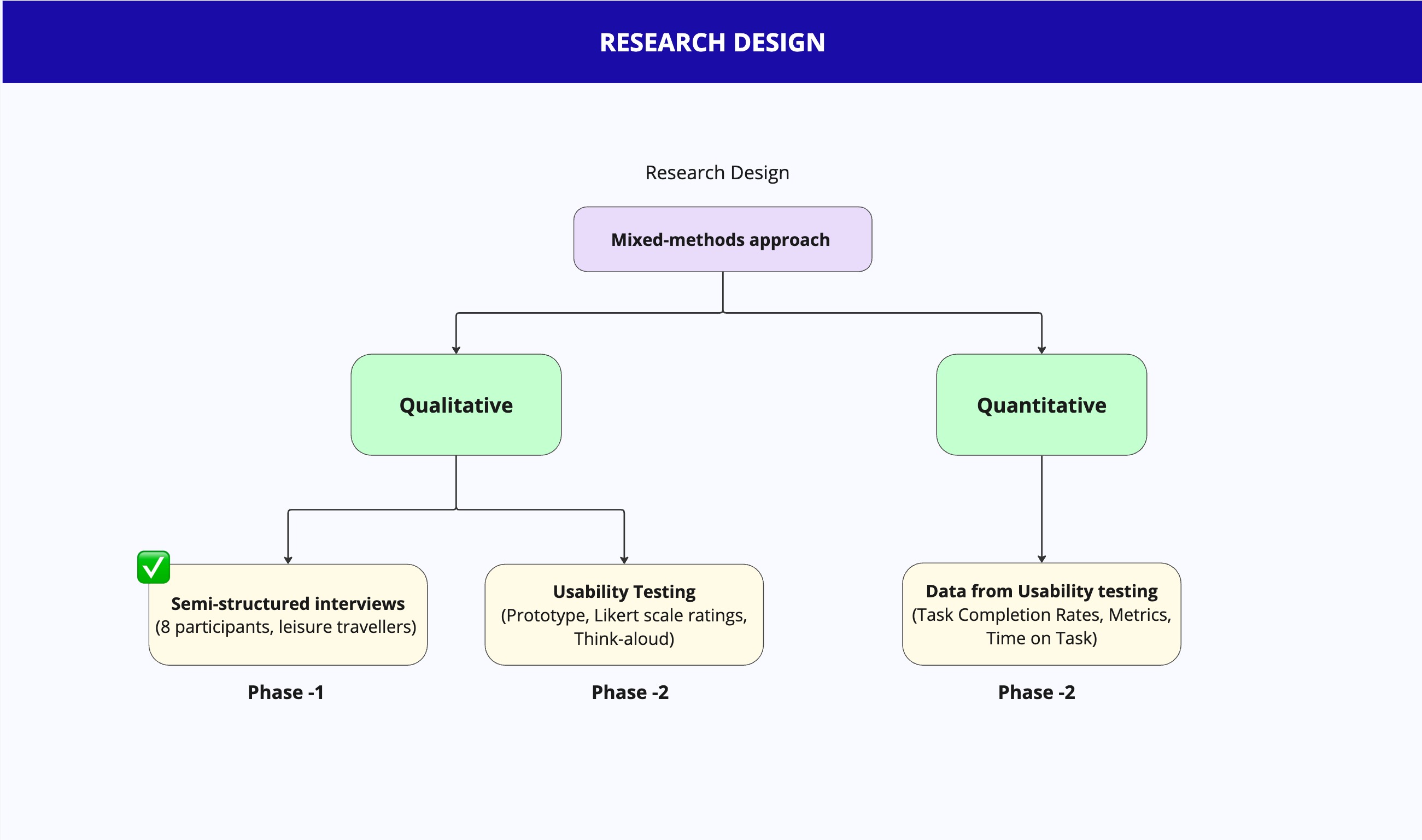
To explore this question, I'm adopting a mixed-methods approach. This combines qualitative and quantitative data collection and analysis.
The research design involves:
- Collecting original data directly from leisure travellers.
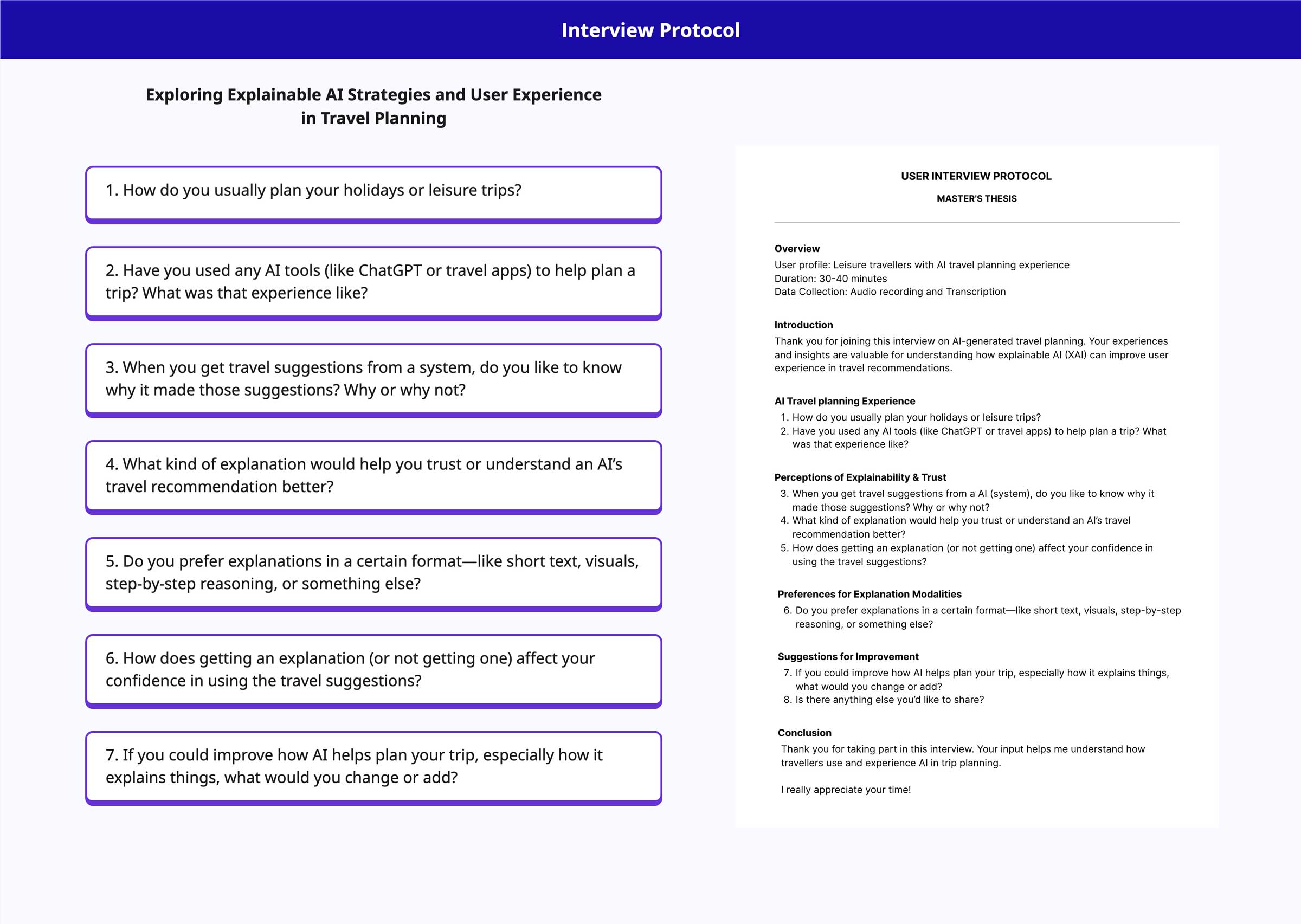
- Using semi-structured interviews to gather in-depth qualitative data.
- Conducting usability testing with a prototype of an AI-generated travel planning tool.
- Recruiting participants for the research.
- Analysing the data using thematic analysis for the qualitative insights and descriptive statistics for the quantitative results.
What's Been Completed So Far
I'm happy to report that the initial phase (Phase 1) of the research is already complete. This involved conducting the qualitative, semi-structured interviews.
I successfully interviewed 8 participants, carefully selected based on their experience with AI and travel planning. The main goal was to understand how they currently plan trips, their experiences using AI for travel, and their first thoughts on 'Explainable AI' (XAI).
This first phase yielded some really insightful findings:
- Travel Planning Methods: Praticipants plan using a mix of ways, including talking to others, using search engines like Google, and visiting travel platforms.
- AI Adoption & Challenges: Only five participants used AI for travel, finding it easy and time-saving. However, they reported significant negative experiences, including problems with accuracy, receiving illogical directions, and the AI hallucinating (making up details).
- Desire for Explanations (XAI): A strong majority really wanted to know why the AI suggested certain things. They asked for the reasons, honesty about sponsorship, and ways to check if the suggestions were valid.
- Preferred Explanation Formats: Participants preferred explanations that were easy and quick to understand, like short text (using bullet points or highlighting) and visuals (such as pictures or interactive maps).
- Importance of Source & Communication: Participants emphasised the critical role of the information source (liking popularity and social proof) and transparency about the AI's limitations. They also wished for AI communication to feel more human-like.
These findings from the interviews provide a solid foundation, directly informing the next steps. They highlight the real user need for transparency and explainability in AI travel tools, especially given the issues reported.
What's Next?
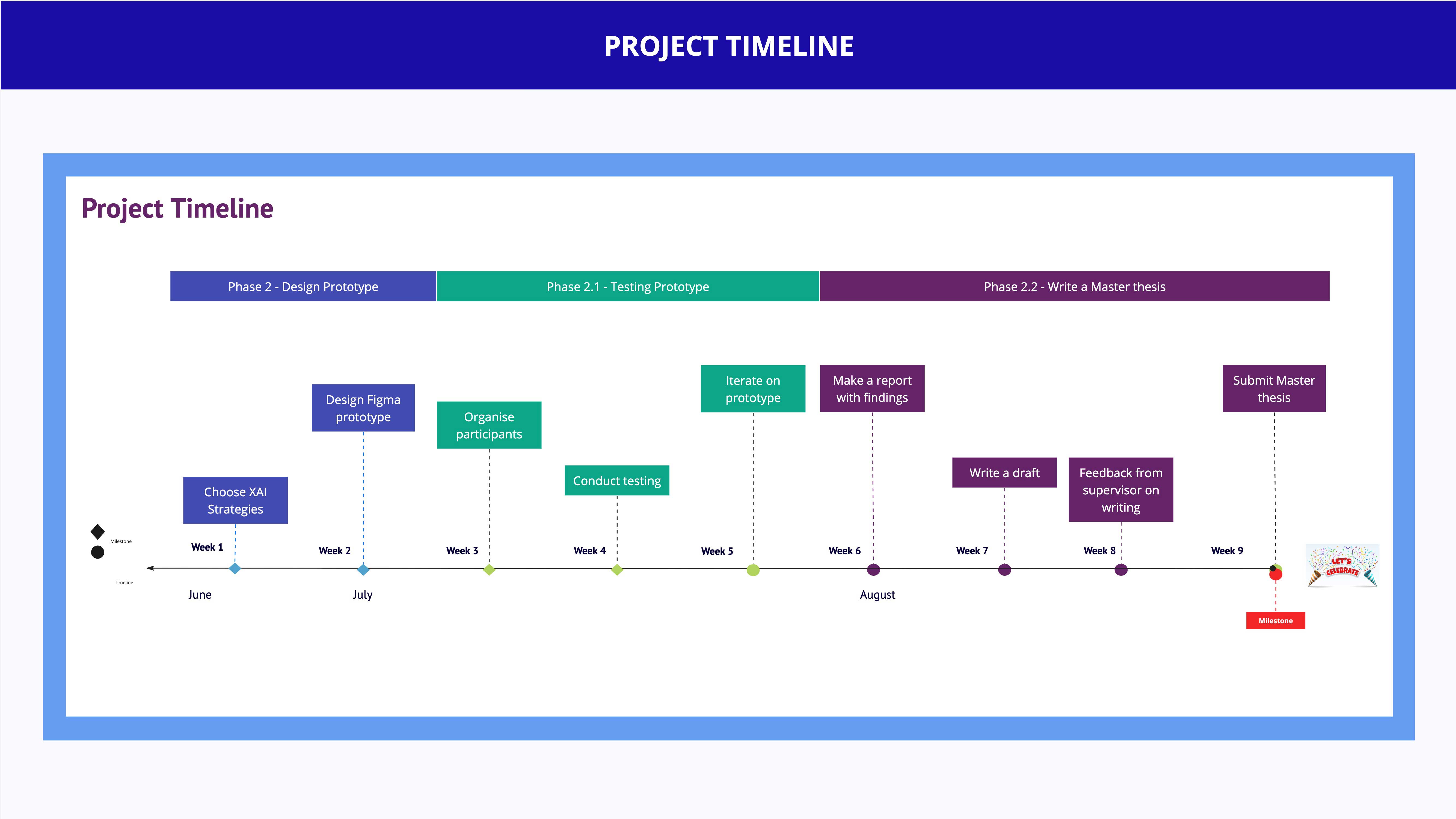
Based on the insights from Phase 1, the next significant phase involves prototype development. I'll be designing an AI-generated travel planning prototype informed by the user needs and preferred explanation formats identified in the interviews.
I'm incredibly excited to move into this next phase. Stay tuned for updates on prototype development and the usability testing process!
Thanks for joining me on this journey. See you next week with more progress!